

Can we imagine oceans ruled by a multitude of jellyfish? Is this a doomsday scenario, or are we actually witnessing a silent invasion of our seas? What will the consequences be for biodiversity?
Every year, a multitude of jellyfish appear out of nowhere and invade our coasts.
In fact, they are already there, present on the ocean floor as small polyps resembling tiny sea anemones.
When environmental conditions—such as salinity or water temperature—change, each of these countless polyps divides, giving rise to a multitude of young jellyfish.
Learn more 
In recent years, it seems that jellyfish arrivals along our coasts have become more frequent and substantial than
in the past. Is this a shift in perception, or a reality reflecting changes in the marine environment? Perhaps a bit of both.
In any case, 200 years of observations in the Mediterranean have scientifically established that the Pelagia jellyfish
(Pelagia noctiluca)
is indeed being sighted with increasing frequency.
It is highly likely that several factors are driving these blooms.
Warming oceans? Overfishing, or even the disappearance of certain predators?
Not to mention their natural cycle—for no two "jellyfish years" are alike!
Moreover, the species encountered in the Mediterranean and along the Atlantic coast vary significantly from one season to the next.
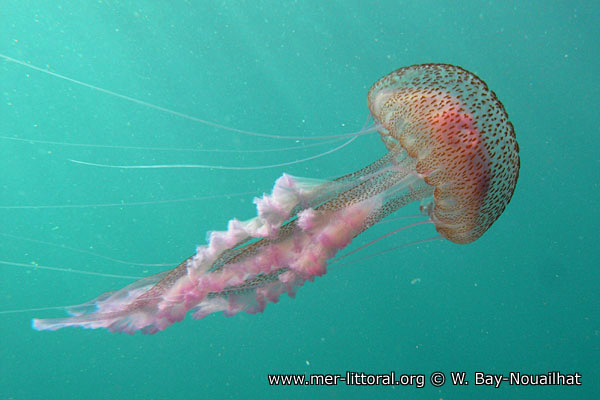
The highly stinging Pelagia
Currently, very little information is available regarding where and when jellyfish appear throughout the year.
Yet, this basic data is essential to determine whether these blooms are isolated incidents
or part of a large-scale shift.
That is why we are organizing Opération Méduses, a major citizen science initiative
aimed at gathering your jellyfish sightings along the entire Western European coastline
to learn more about the distribution, abundance, and frequency of these little-understood creatures.
To participate: Access the reporting form
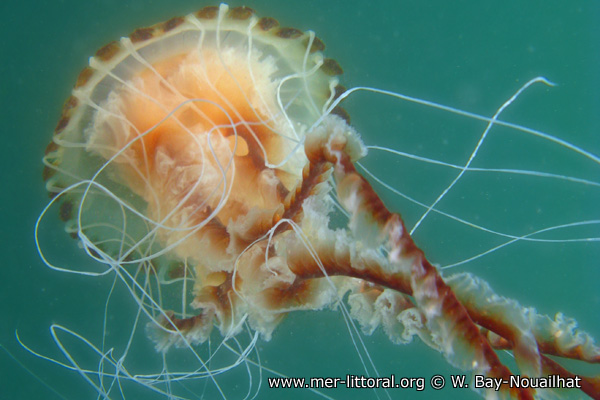
Tentacles of the compass jellyfish
Jellyfish are planktonic animals, meaning they "wander" through seas and oceans,drifting with the ocean currents.
They are carnivores that feed on plankton, small crustaceans, larvae, and small fish, capturing them with tentacles covered in stinging cells. Upon the slightest contact,
these cells act like a multitude of tiny, venom-laden harpoons.
Find out more .
They paralyze their prey, which is then conveyed to the mouth.
They do not distinguish between contact with food, a predator, or a swimmer.
Therefore, they do not sting us intentionally, but rather by accident.
Nevertheless, these stings claim many victims every year.
All jellyfish sting. This causes a burning sensation, the intensity of which
varies depending on the individual and the type of jellyfish.
Do not assume you are immune simply because a previous encounter with one of these creatures was painless. Their venom sensitizes your body,
and subsequent stings can trigger a severe allergic reaction.
A few simple rules can save you a lot of trouble:
do not swim among jellyfish, do not play with them, and stop children from doing so.
Do not touch a beached jellyfish—even one that has been dead for hours—as the venom remains active.
Do not touch objects that have come into contact with jellyfish, such as ropes, fishing rods, nets, or buckets.
Stinging tentacles may be stuck to them.
If stung, gently remove any remaining tentacles using a tool, paper, plastic, a seashell, or even a piece of seaweed.
Do not use any harsh liquids, as this could trigger inactive stinging cells: avoid vinegar, saliva, and even fresh water; instead, gently rinse the wound with seawater if necessary.
If pain persists or you feel unwell, consult a doctor.
To participate: Access the reporting form
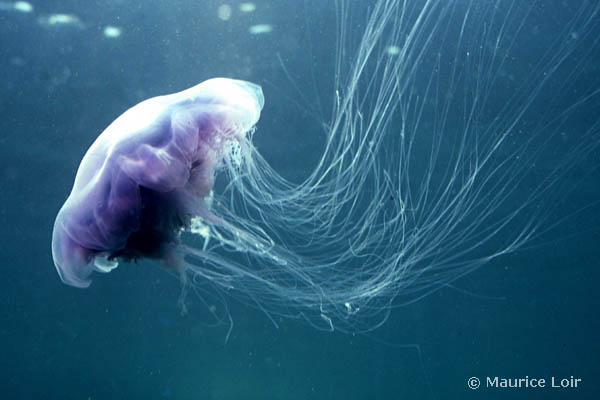
Blue jellyfish and its trailing tentacles
© Mer et littoral 2004-2026 - All rights reserved
The texts and images on this website are not free of rights and cannot be copied and/or used without the agreement of their respective authors.